February 17, 2026
technology
Filed from Northern California, February 17, 2026.
When agents become your heaviest users, the build order has to change.
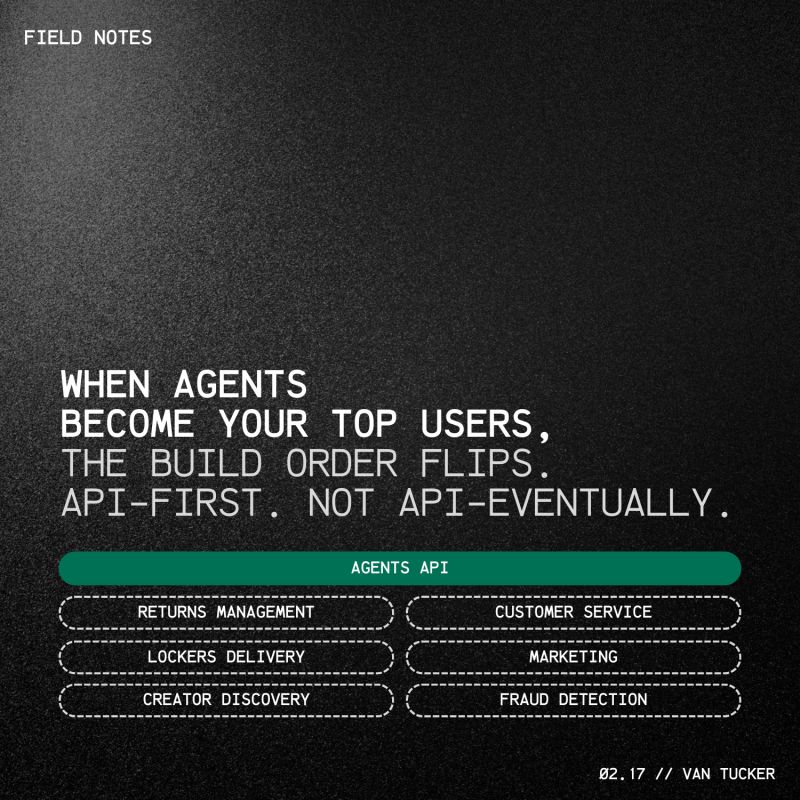
When agents become your heaviest users, the build order has to change. API-first. Not API-eventually.
Software used to be built for people first. APIs got bolted on later. That made sense when humans were the primary users. But look at what's already shipping with OpenClaw, Codex, Claude Code, Manus agents doing 10x or 100x the volume of work a person does inside a tool.
When agents become your heaviest users, the build order flips. API-first. Not API-eventually.
The UI doesn't disappear. Its job changes, it becomes where humans verify, collaborate, and work on output alongside the agent. Not the primary way things get done.
This is what I wrangle every day wiring agents into real commerce and operations workflows. The tools with clean APIs? Agents plug in and produce value in minutes. The tools built around dashboards with no API layer? I'm burning half the build just finding workarounds.
The use cases are already here: Returns management: Agents triaging return requests, classifying condition, routing to the right disposition path, and updating inventory. All API calls. No human clicking through a portal.
Alternative delivery with lockers: Agents coordinating carrier handoffs, assigning locker compartments, triggering customer notifications, and managing pickup windows. The entire flow is machine-to-machine until the customer walks up.
Creator discovery: Agents scanning, qualifying, and matching creators to brands based on audience fit, engagement signals, and campaign goals. What used to take a team a week of spreadsheet work now runs in hours.
Fraud detection: Agents monitoring transactions in real time, cross-referencing behavioral signals, flagging anomalies, and auto-holding suspicious orders before they ship. By the time a human reviews the queue, the agent has already sorted the noise from the real threats.
Every one of these breaks down when the tools underneath aren't API-first.
The good news? There's still a massive window to get this right. The teams that make their products agent-ready now become the default infrastructure for the next generation of workflows.
Mailing List
Join Field Notes
New notes on AI, building, and life from Northern California — plus the occasional printed mailing.